The Hermitage Cats
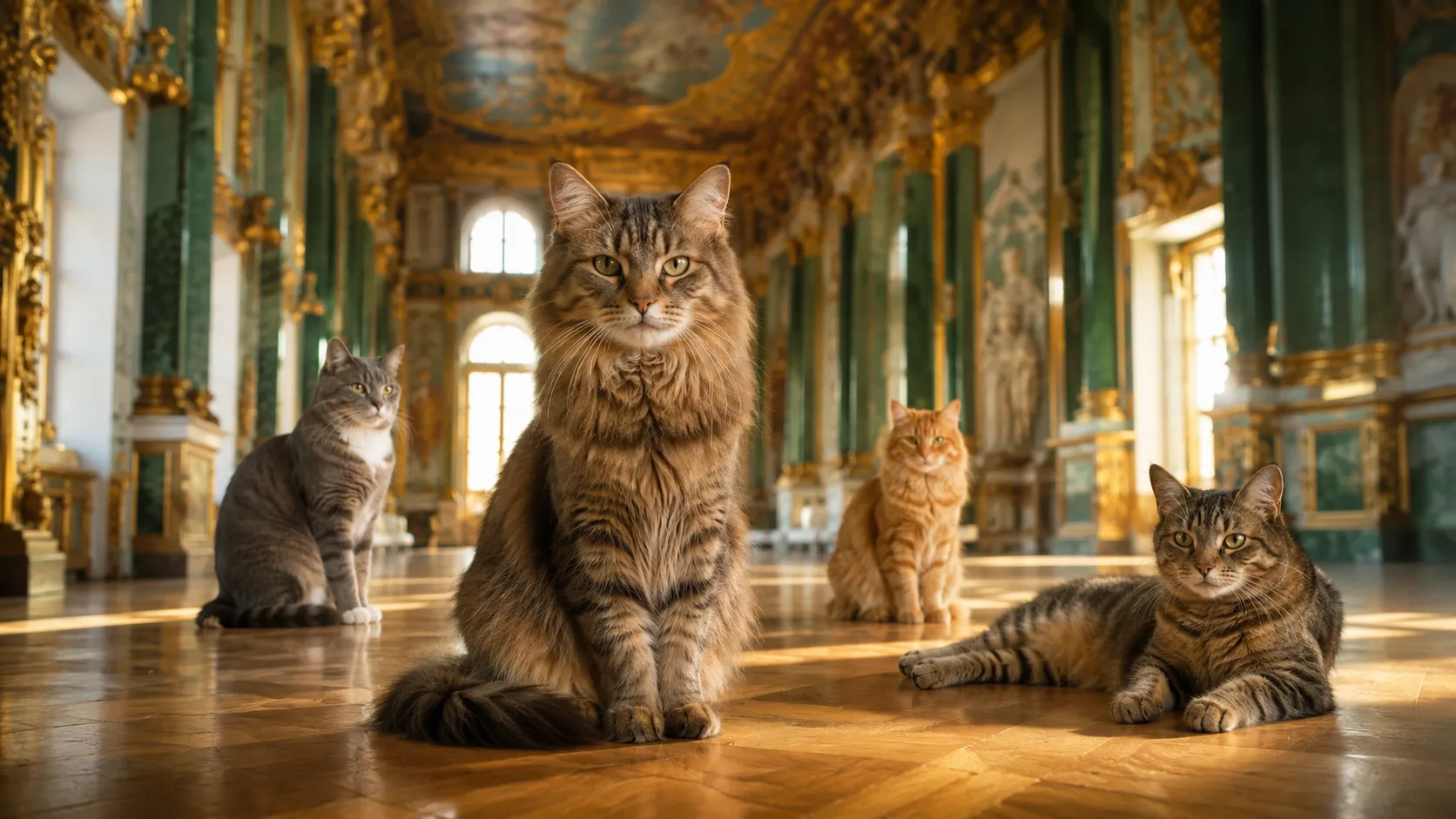
The Hermitage has its own furry “security service” — the Hermitage cats. They live in the cellars of the museum complex, protect the priceless collections from rodents, and have long been one of the museum’s best-loved symbols, written about even by the foreign press. The cats are not allowed into the galleries — their kingdom is the floor below.
A history at court
Cats appeared in the imperial residence as early as the 18th century. By tradition the first was a cat named Vasily, brought by Peter the Great from a Dutch merchant. But the real “cat story” began under his daughter: in the autumn of 1745, Empress Elizabeth issued a “Decree on sending cats to the court” and ordered some thirty large mouse-catching cats brought from Kazan to protect the Winter Palace.
Under Catherine the Great the cats stayed on officially as “guardians of the picture galleries.” With interruptions, they have served the Hermitage ever since — for more than two and a half centuries.
How many cats are there now
Today around fifty cats live in the museum’s cellars — a limit the museum set so that all of them get enough room and care (the director, Mikhail Piotrovsky, spoke of it around the museum’s 250th anniversary). Staff and volunteers look after them; the cats have their own rooms, bowls and sleeping places, and there is a small charitable fund to help them.
Passports and “posts”
Every Hermitage cat is a small legend with paperwork:
- each cat has its own passport and veterinary record;
- formally it is listed as a specialist in clearing the museum cellars of rodents;
- the cats are vaccinated, treated and neutered, with vets watching over their health.
Most of these tailed guardians are ordinary mixed-breed cats, many of them once strays.
The Day of the Hermitage Cat
Once a year the museum holds the Day of the Hermitage Cat (usually in late spring), with tours of the “cat” cellars, children’s programmes and contests. The event has become a notable city occasion and draws attention to animal welfare.
Adoption: you can take a cat home
To stay within the limit, some of the cats are rehomed. Would-be owners can apply, meet a cat and take it home — and so the Hermitage cats spread to towns across Russia. It’s one reason the museum’s cats are known far beyond Saint Petersburg.
Cats as a museum brand
The Hermitage cats have long outgrown the cellars: they feature in news stories, on souvenirs and in books, and are drawn on postcards. For many visitors they are the warm, human side of a vast museum — and a good reason to get to know the Hermitage from an unexpected angle.
FAQ
How many cats live in the Hermitage? About fifty — the museum deliberately keeps roughly that limit.
Why does the Hermitage keep cats? To protect the collections and cellars from rodents; the tradition goes back to Empress Elizabeth’s decree of 1745.
Can you see the cats in the galleries? No — cats are not allowed in the exhibition halls; they live in the service cellars.
Can you adopt a Hermitage cat? Yes — the museum rehomes some of the cats by application.
This is an unofficial, informational website. Details of the programmes (the Day of the Cat, adoption) change — confirm them on the official museum website. Plan your visit with the one-day itinerary and the floor plan.